When you say ‘Goa’ what instantly comes to mind is a picture of a wide sunny beach, beautiful blue sky and swaying palm trees. Paradise indeed, because Goa’s 82 mile coastline has some of the world’s best beaches. Though the beach area is rapidly getting built up, there are still vast areas of beautiful unspoilt beaches to enjoy. Deciding where to go can be difficult but if you are looking for plenty of company, Calangute, Baga & Chapora have it all – a great beach, lots of people, loungers, interesting beach front eating shacks and during the season (November to April) - music and dancing.
Calangute and Baga A bracing breeze and perhaps the sight of fishermen taking in the morning’s catch will greet early ramblers on Calangute. In the day though it witnesses considerable activity owing to its overwhelming popularity. If you want to be in the thick of things, then head for it. This southern stretch of the Candolim beach has everything from henna artists to bhelpuri stalls, kashmiri handicraft merchants, tribal women selling artefacts, masseurs et al. However their incessant hassling and pressure selling can become tedious. If you are going to buy, bargain very hard and don’t be afraid to offer a price far below the price first quoted.
Quieter beaches are Anjuna, Chapora, Arambol and Vagator, with Benaulim, a near deserted paradise falling somewhere in between.
Calangute and Baga
A bracing breeze and perhaps the sight of fishermen taking in the morning’s catch will greet early ramblers on Calangute. In the day though it witnesses considerable activity owing to its overwhelming popularity. If you want to be in the thick of things, then head for it. This southern stretch of the Candolim beach has everything from henna artists to bhelpuri stalls, kashmiri handicraft merchants, tribal women selling artefacts, masseurs et al. However their incessant hassling and pressure selling can become tedious. If you are going to buy, bargain very hard and don’t be afraid to offer a price far below the price first quoted. The entire offshore stretch from Calangute to Baga is dotted with a quaint assortment of hotels and eating-places. The ambience ranges from old-style Portuguese to modern and is part of the unique charm of Goa.
Calangute's heyday as the Mecca of all expatriate hippies has passed and it has undergone a metamorphosis to become the centre of Goa's rapidly expanding package tourist industry. It isn't one of the best Goan beaches, but there's plenty going on and people who find some of the other beaches too quiet may find Calangute more to their liking.
The beach at Baga is for those wanting calm and repose. The landscape is more interesting. The estuary at the end of the Baga beach is particularly beautiful and the river is ideal for inexperienced swimmers.
beach is particularly beautiful and the river is ideal for inexperienced swimmers. North of Baga
To the south of Calangute lies peaceful Candolim, one of the lesser known of Goa's beaches. But the traveler who ventures further north of Baga will be rewarded with a series of secluded and serene beaches. The rocky Vagator with its creeks waiting to be explored, is irresistible for many. A canopy of dense coconut plantations sets the backdrop for the ramparts of Chapora Fort, dominating the surroundings from atop a rocky hill. Chapora is a short walk from Vagator beach and is well worth a visit.
Anjuna Beach
Swaying palms, sandy coves, and an unspoilt tranquility mark Anjuna and Vagator. Anjuna, once the haunt of the flower children - fugitives from Western civilisation - still retains memories of those carefree days. Famous throughout Goa for its Wednesday flea market, this is the beach that everyone went to during the flower power era of the hippies. Anjuna is different things to different people. The only way to find out is to go there and find out on your own. Full moon is the time when the parties take place. Unlike Calangute, the place has retained its charm.
Take great care of your possessions in Anjuna, particularly on party nights, as theft is a big problem. The bank has safety deposit boxes, which you can use. You should also take care not to waste water because there's an acute shortage, especially late in the season.
Chapora and Vagator
This is one of the most beautiful and interesting parts of Goa's coastline. Most of the village areas nestle under the shade of the coconut palms. Chapora village is dominated by a rocky hill on top of which sits an Old Portuguese fort, which affords excellent views from its rampart. Secluded sandy coves are found all the way around the northern side of this rocky outcrop. You'll need to have a torch handy as there are no streetlights and finding your way along the paths through the coconut palms is not such a romantic idea.
Little Vagator, the beach to the south, is very popular with tourists and a lot of people from Calangute and Baga come up here for the day..
Varca and Cavellosim
The 10-km strip of pristine beach south of Benaulim has become Goa's resort beach with at least half a dozen hotels of varying degrees of luxury.
The 10-km strip of pristine beach south of Benaulim has become Goa's resort beach with at least half a dozen hotels of varying degrees of luxury.
Arambol
The hippie refugees who were ousted from Anjuna in the hey-day of flower power and acid-rock parties, came to Arambol and fell in love with its surroundings. The seashore is beautiful and the village is quiet and friendly, with just a few hundred local fishermen and a couple of hundred westerners during the November-February high season. The main beach is a good place to swim but up north, there are several more attractive bays and a freshwater pool, whose mud is supposed to be good for the skin.
South Goa Beaches
But no matter where you settle, the soft sands of Colva hold out the promise of sheer enchantment.
Benaulim is another beautiful beach of this part of Goa. Then there is Bogmalo beach, a stone's throw from the airport. A short drive from Panjim brings you to the tranquility of Siridao beach, a small, secluded beach that is a haven for shell collectors. Southernmost of Goa's beaches are the beautiful sands of Betul, with its aura of sublime peace.
Many of the beaches now have well-developed beach resorts which enable you to combine the comforts of a furnished cottage with the enjoyment of the outdoors.
Colva Beach
Southern Goa boasts a fascinating collection of unspoilt beaches. Of all these, though, the silver sands of Colva are the most beautiful. Few would disagree if Colva were crowned the Queen of Goa's beaches. 40 km of uninterrupted white sand fringed with swaying palms and calm turquoise waters mark the extents of Colva. In the moonlight, the water here is said to take on a magical luminescence adding to the wonder of this loveliest of Goa's beaches. Finding your own isolated stretch of beach is easy, as only parts of Colva have been properly developed.
Twenty years ago, precious little disturbed Colva except the local fishing people who pulled their catch in by hand each morning and a few of the more intrepid hippies who had forsaken the obligatory sex, drugs and rock & roll of Calangute for the soothing tranquility of this paradise. Since there were only two cottages for rent and one restaurant (Vincy's), most people stayed either on the beach itself or in palm-leaf shelters, which they took over from departing travelers or constructed themselves.
Those days are gone forever. Even in days of yore, the property speculators and developers had begun to sniff around in search of a fast buck. Today, you can see the results of their efforts - air-conditioned resort complexes, close-packed ranks of tourist cottages, discos, trinket stalls and cold-drink stands. Between the Bus Park and beach, the small stream now runs black with pollution, unthinkable in the days gone by.
Bogmalo Beach
Eight km from Vasco and only four km from the airport is Bogmalo Beach. It's a small, sandy cove dominated by a five-star hotel. There's little here apart from the resort hotel and a couple of smaller places to stay, the reasonably pleasant beach, several expensive beach cafes and the small village of Bogmalo.


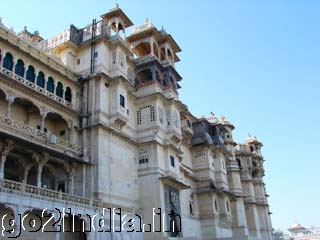 Present main entrance is known as elephant gate. At this place elephants were used in tug of war games in the presence of Kings and royal cabinet. This palace started by Maharaja Udai Singh but further additions were made by his predecessors. All new additions were well matched with the old structure so this palace became a conglomeration of eleven palaces. This palace houses terraces, pavilions, corridors, courtyards, rooms and hanging gardens. Maharaja Udai singh started this palace on the advice of a holly sadhu and constructed a shrine there. This shrine is the oldest part of the palace and now known as Dhuni Mata. Exactly above the place where the holly sadhu was sitting there is a bucket shaped big container. Coins kept in this container and then donated to people after the kings take over the charges of the country.
 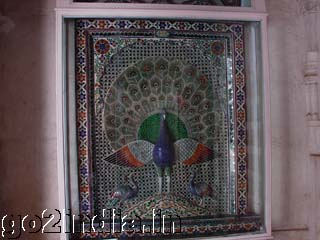 Maharana Karan Singh had added fine peacocks constructed in relief mosaic. These peacocks are kept inside glass windows for the tourist to watch the colorful design. This place is known as Mor Chowk
 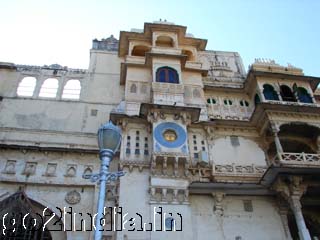 Maharanas of Mewar are Surya Vanshi or decedents of Sun god. So they daily pray the sun god. One big sun god status made of Gold is available inside the palace and the kings use to perform puja here on the cloudy days when sun god is not visible. Outside the Palace there is another status of Sun God for general public to offer their pujas.
 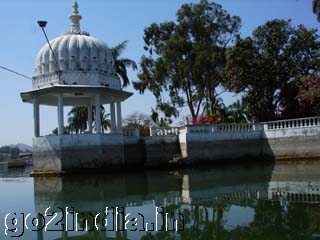 Udaipur is the known as city of Lakes is one of the major tourist destination of Rajasthan state. This city was founded by Rana Udai Singh in the year 1553 AD. Its Location is 24.31 north latitude and 73.42 east longitudes. This city became the new capital of Ranas of Mewar after the death of Maharana Pratap in 1597.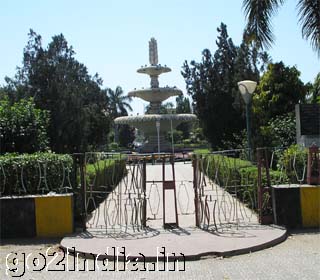
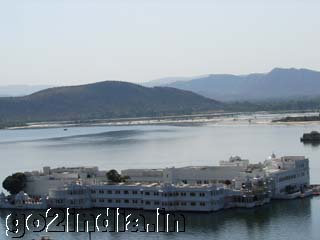 Now used as a luxury hotel this Lake Place was built by Maharaja Jagat Singh II in the year 1754. Located on the island Jag Niwas this was named as Jag Mahal by its founder. This beautiful palace located inside the Lake Pichola has put Udaipur in world Luxury tourist destinations. This Lake Palace construed by using marble stones has a mixture of Moghal and Rajput architecture. This palace was subsequently used by Maharajas as summer resort. Taj group of hotels now manages this Lake Palace.
 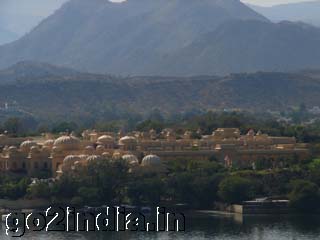 By the side of Lake Pichola this is another palace built by Maharaja Karan Singh. This palace built by precious stones is another beautiful palace in Udaipur. Prince Kurram who subsequently became Mughal emperor Shahjahan took refuse here when he rebelled against his father Jahangir. Shahjahan was the son of a Rajput queen. It is from here Shahjahan was impressed by marvelous architecture and subsequently used the idea in constructing famous Taj Mahal.
 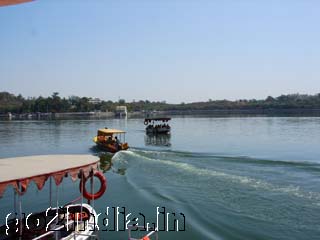 This beautiful lake is surrounded by hills was constructed Maharana Jai Singh in the year 1687. Due to heavy rain the old embankment of the lake was swept away then Maharana Fateh Singh reconstructed this lake in the year 1888 so the name given to this Lake is Fateh Sagar Lake. This is 2800 ft long and its maximum depth is 30ft. Every year a festival named as Hariyali Amavasya Mela organized here in the month of Shrawan. A good road passes by the side of this lake and gives spectacular look with the reflection of side by hills in water. Light shows are arranged in the evening hours.
 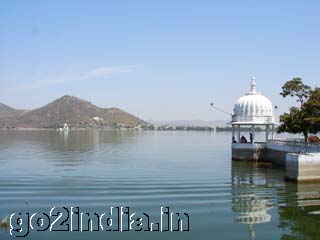 At the center of the Fateh Sagar Lake an island park is there and it is known as Nehru Park. There is a boat shape café available and near the park. One solar observatory is located in this island. From the bank of the lake boat service is available to visit the park. Charges are Rs 50 per person to visit the park ( both way ) and minimum 6 persons are required to book a full boat. On the way to the center of the Lake the boat will take a turn around the other side of the Lake before reaching the park.
 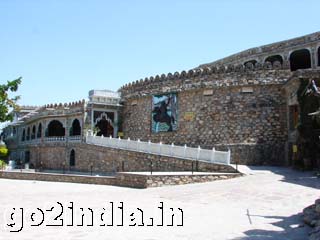 Haldighati is located at a distance of 40 KM from Udaipur is famous for the battle took place here on 18th June, 1576 between Maharana Pratap Singh of Mewar and Mughal army of Akbar of Delhi. There is a museum storing many weapons and paintings of the famous battle. Light and sound shows give a glimpses of the events inside the museum. Entry ticket is Rs 20 and camera ticket is Rs 10 to carry inside. Inside the museum in some places particularly near the light and sound show photography is not allowed. Visitors can keep the camera with them.
 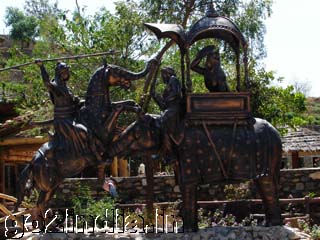 During the battle Rana Pratap Sing's horse Chetak got injured as one of its leg got cut when Rana Pratap attacked the elephant of Man Singh. To save the life of Pratap Singh the injured horse took his mater away from the battle field and cover a safe distance. After jumping a 22 ft river it collapsed and died. This place is marked with a Chetak Samadhi. This circumstance had forced the Rajputs to retreat and the struggle ended at mid day of 21st June 1576 AD
 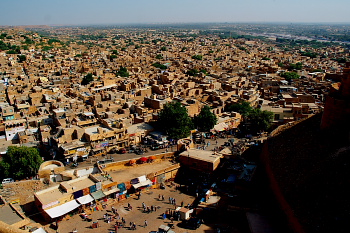 Located at the western part of the Rajasthan state this small town was once popular as a trade route and lost its position once the trade was shifted to sea route. But Jaisalmer remained as a famous tourist destination of India for its unique town style, culture, forts and most important is for its Thar Desert.
  To collect precious rain water this tank was constructed by Rawal Gadsi Singh in the year 1367. At present Gadisagar ( Also known as Gadisar) tank gets water from Indira Gandhi Canal so it never dries. There are nice designed temples and shrines located by the side of the Gadi Sagar lake. At the center there is a big domed pavilion. Boating facility is available in this lake where charges vary from type of boat and based on duration of boating. Sikaras are also available to go around the lake.
  This is the present residence of erstwhile royal family. Part of this palace is used as a restaurant and hotel. This is a beautiful carved palace with many attractive galleries and paintings. There is an entry fee of Rs 10 to enter into the visitors area. Private area and the restaurant is not allowed for the visitors to enter. At the top of the building the picture of Jaisalmer fort and town is visible.
 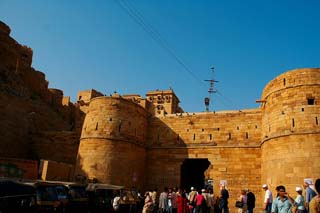 The most important tourist attraction is the Jaisalmer fort. Using yellow sandstone this fort was constructed by Bhati king Jaisal (AD 1155-1183). Because of the yellow color this fort is known as Sonar Qila or golden fort. There is a stone wall of 5 KM in circle and 2 to 3 meter in thickness. The construction was started in 12th July 1155 and it took seven years to complete. Subsequently many new additions done by subsequent kings. This fort has witnessed many battles with Khilji, Tughalaqs, Mughals and other Rathore kings.
 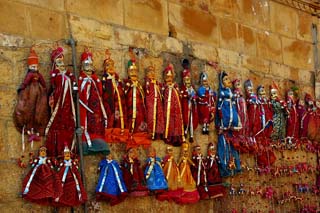 This majestic fort is visible from all the locations of the town and this fort houses many families and you will have a different feeling while visiting this place. Inside the fort you will find kids going to school, vegetable venders, and milkman's selling milk on bikes and many crafts showrooms selling traditional handicrafts products. This is like any other daily life of a small Indian town. No other forts of Rajasthan have so much regular life within it. In early days the forts were constructed as a protection against outside invaders so all the families along with the king were staying inside the fort. With the population growth and falling of kingdoms people stated staying outside the forts so the city near the forts started developing.
 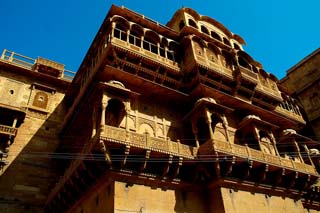 Guides are available but rates are not fixed here. There is an upward slope to approach the center of the fort where the main museum is located. This center of the fort is known as Dussehra Chowk, here the seven storied Raj-mahal now known as Jaisalmer Fort Palace Museum & Heritage Centre is located. The entry fee is Rs 30 for Indians and still camera is Rs 50. For foreigners the fee is Rs 250 with audio guide and including one still camera. The fee for Video camera is Rs 100.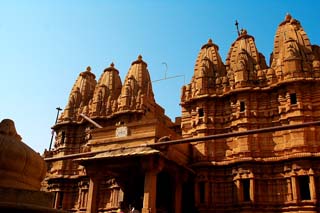
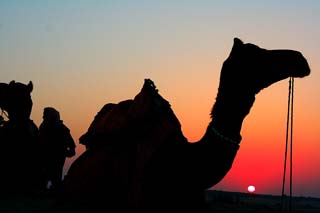 Sam is located at a distance of 42 Km from Jaisalmer town. This place is a famous tourist spot of this area. There are sand Dunes here where sun set can be enjoyed. The combination of sand Dunes and camels with sun at background gives a spectacular look. Many tourist carry cameras with tripods to take some photos on low light condition as this is the best place for Silhouette Photography. As soon as you arrive at this point local camel owners will offer you a ride. The sand Dunes are located very close to the vehicle parking area but if you prefer to walk then at every step you will be offered a camel ride at a very attractive price.
 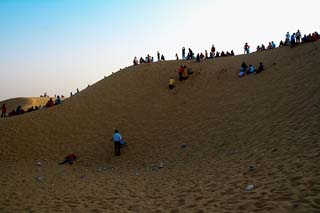 While on the sand Dunes you will find local kids offering you coffee, tea and cool drinks etc . All drinks are offered in plastic cups without any proper disposal system, so it is better to avoid them.
 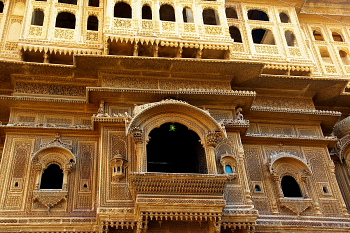 Havelies are part of the Rajasthan culture and symbol of tourism. In most of the travel photos you will find beautifully carved projected balconies. These are Havelies of Rajasthan. These Havelies displays erstwhile gracious living standards of some business mans, royal priests, Rajputs, thakurs , Marwaries, Muslims & treasury in charges ( Kotharies ) etc. These Havelies are different in different locations of Rajasthan. Rajput Havelies are different than Marwari Havelies and in same way royal priests Havelies are different than thakurs Havelies. Havelies are there in almost all towns of Rajsthan but some of them lost their identity and in some havelies still the families are staying. There are some important Havelies located in Jaisalmer town. One of the famous one is Patwan Ki Haveli
 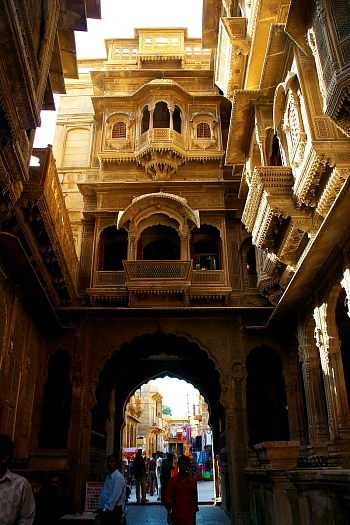 Located at the town center this Patwon Ki Haveli was constructed by a Marwari business man Guman Chand Patwa and his five sons. Before the development of sea trade Jaisalmer was the part of the silk route connecting to middle east. Patwons were dealing with gold brocade & silver. There are five havelies located within the complex for the five brothers. In those days it was estimated that in total Rs 10 Lakhs ( one million ) was spent for the construction of this haveli. This was done when people Jaisalmer were facing famine and this has helped them for their survival. Hindu and Muslim craftsman hailing from Gujrat, Malwa and Sindh worked in constructing these havalies. The location of the havelies are selected based on the protection from rough sandy winds.
 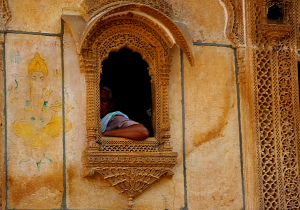 This is an example of Indo –Islamic architecture. Inside the havelies there are galleries and places for House temple, Drawing room, Dining Hall, Bed room, Kitchen room, Turban collection, Locks collection, Chambers, Painting collection and fans. The turban gallery displays types of turbans used by people reflecting different casts and cultures of the state. Read more on the
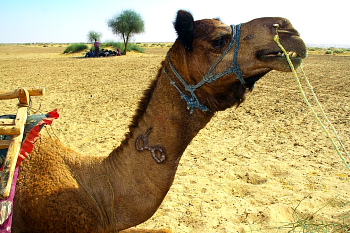
 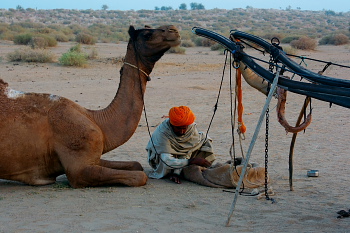 Camels are known as ship of the desert. The villagers inside desert area keep camels as domestic animals and earn their livelihood through this animal. What is the cost of a camel? My guide replied that it varies from Rs twenty thousand to thirty thousand. So this is not a small amount for a villager in India so how do they identify this animal as their own when there are many moves around each village or inside the jungle area ? I got this doubt and asked to my guide. Every camel will carry a mark below its ear representing the village of the owner. So you can see marks below the ear for BEEDA or HATTAR ( name of two villages inside desert ) depending on which villages it belongs.
  Camels are used as for transporting goods by using a cart or by loading goods on the camel. Villages they are used as main transport for shifting goods. Special water tanks are used for bringing drinking water to different places inside desert. Camels particularly those used for tourist safari are decorated with nice cloths and ornaments.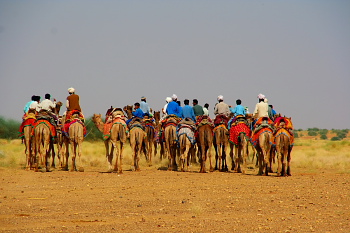
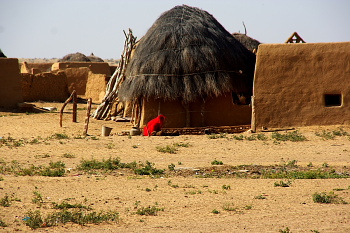 After two KM or walk we entered to Bedda village. Took rest in the village school and opened our lunch packs. Bedda is a small village and is connected to Jaisalmer by road through Sam. Kids were watching us with lot of curiosity and were very happy after getting some chocolates from us. Some of them helped us in getting soft drinking water from the village. After a short break we left for our camp which was at a distance of 3 KM from the village.
 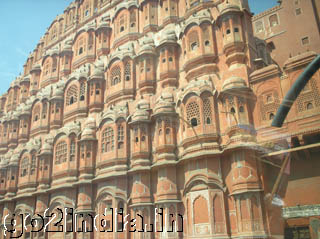 Popularly known as pink city, Jaipur is the capital of Rajasthan state. This city was founded by Sawai Jai Singh II in the year 1727 AD. This city is well connected from all other parts of the country by rail , road and air network. Located at a distance of 272 Km from Delhi and 228 Km from Agra this city is part of the popular golden triangle of tourist circuit consisting of Delhi, Agra and Jaipur. Proximity to Delhi and Agra ( Taj Mahal ) with its reach history of Indian Maharajas this city attracts many tourist from all part of the world.
 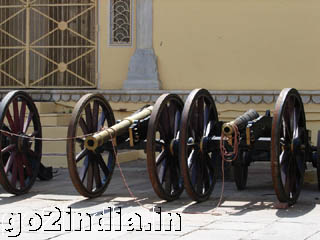 This has one of the fine collections of arms, edged weapons and antique of the country. The edge weapons include Mughal shamshirs, curved swords, double edge cutters, daggers, axes, pointed gupties, knives, and arrows of different size and shapes. There is a sword in which Emperor Shah Jahan name is inscribed. Some swords with names of Mughal and Persian emperors. Many personal weapons of Maharaja Ram Singh II and Madho Singh II are in display.
 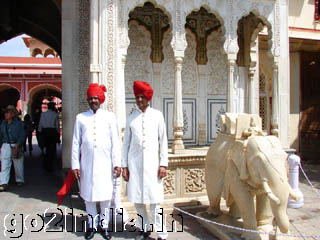 In the year 1931 Rajendra Pol, the entrance to the interior courtyard with two elephants on two sides were constructed on the occasion of birth of Maharaj Jumar Bhawani Singhji ( the present Maharaja of Jaipur )
 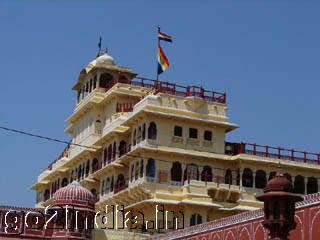 Chandra Mahal is the residence of Royal family of Jaipur. This is a seven storied building. At the top of this the flag of Kachhawaha is placed..After defeating the five Pathan chiefs beyond North – Western frontiers there flags were presented to Emperor. This Panchranga ( five color ) flag is created in combination of five flags and became the flag of Amber and then accepted at Jaipur once the capital is shifted from Amber to Jaipur by Sawai Jai Singh in 1727. Mughal Emperor Aurangzeb conferred the title “Sawai” to Jai Singh II. Thus one additional flag was put above the main flag to mark the title after this event. These fags can be seen inside the city palace above the Chandra Mahal.
 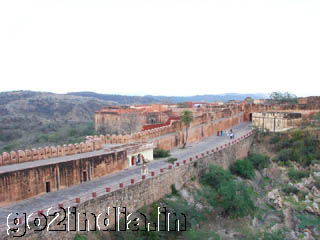 Jaigarh fort was built over a rocky hill known as Cheel Ka Teela (mound of eagles) mainly for defense purposes by Mirza Raja Jai Singh during 1621 – 1677 AD. This fort was subsequently developed by his succeeding rulers. Maharaja Jai Singh II completed this and named it as JAIGARH in the year 1725 AD. This fort has huge walls and gates.
 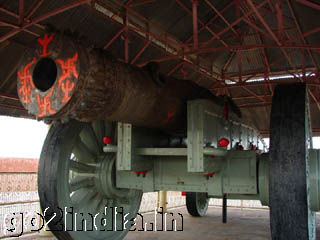 The main attraction of this fort is World's biggest wheel mounted Cannon Jai Baan. This twenty feet long barrel is made of alloy steel and its weight is 50 tons. There is an arrangement of turning the gun by wheels and roller fix pins. Its main wheels on which it stands is of 9ft height. 100 kg of gun powder can be loaded to on the cannon. This big cannon was cast in the year 1720 AD during the period of Maharaja Sawai Jai Singh II.
 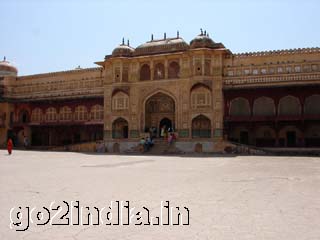 This majestic fort was the capital of Kachhwaha before Jaipur. Located at a distance of 11 KM from Jaipur this big fort was the center for nearly six centuries. If you are traveling by public transport or by tourism bus services then you have to take help of local jeep service to reach the Gate of the Amber Fort. Both ways it is Rs 20 per head. The Jeep will take you to the entrance of the fort by passing through narrow lanes of the small locality developed around this fort.
 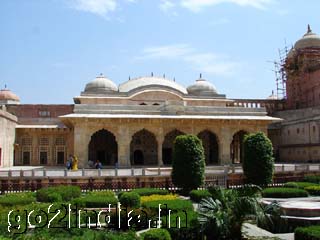 The main fort has Diwan-i-Khas or the private meeting hall, Diwan-i-Am or the Hall for the public audience, Sukh Niwas or the Hall of Pleasure, Sheesh Mahal or the hall of mirrors, Jai Mandir or the Hall of Victory, and Jas Mandir or Hall of Glory etc. Sheesh Mahal is the most beautiful one where mirrors are placed on walls and roofs of the rooms. These places were used as sleeping rooms for royal family, with one candle light with many reflections in all mirrors the rooms was giving a feeling of open sky. In the summer house of king marble walls were made of layers of slabs allowing water to pass between them. Water flows from top tank through these walls and gets collected in the open garden for further recycling. This way the rooms were kept cool for the royal family. There are different sections for different queens inside the palace and king has access to each queens area separately.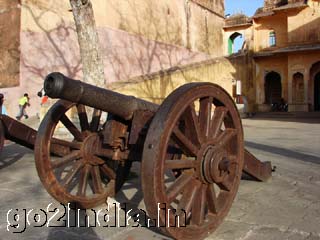
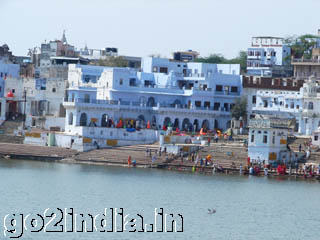 Located in the middle of Rajasthan, Pushkar is a religious centre and is 14km (9 miles) from Ajmer. The name Pushkar means 'a pond created by a flower' and, according to the Padam Purana (a Hindu religious text) came into being when Lord Brahma dropped three petals from a lotus flower down to earth in an attempt to kill a demon. At the point where each petal struck the ground, a lake formed. The largest of these is revered as one of India's most sacred sites, and is surrounded by temples and 52 bathing ghats. To bathe at Pushkar in one of these ghats is believed to be more important than at any other place in the world, because Pushkar is considered to be the home of Lord Brahma and is reputed to have the only temple in India dedicated to him. It is the prime reason why Hindu pilgrims visit the town.
 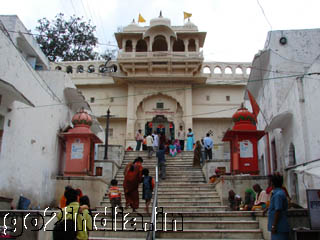 Between October and November the famous five-day camel fair takes place. During this time, numerous competitions are held such as camel racing, horse racing, donkey racing, and camel-cart racing. In this part of India, the men sport very colourful (and large!) turbans and the women add to this riot of colour with their local village dress of gargara skirt, the design often specific to their caste or village. The festival itself is a major tourist attraction, but it is well worth hanging around after the racing for the "aarti" (evening prayers) after which hundreds of lamps are floated on the lake (known as "deepdan"), and the entire surface is illuminated.
 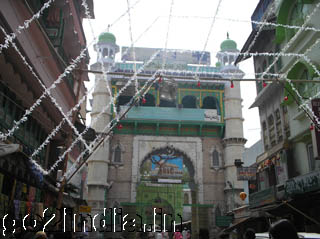 This is a sacred secular town of Rajasthan. Ajmer located inside Aravali hills was founded by Ajaipal Chauhan in 7th century and became the center of Chauhan Rajputs. After the defeat of Prithviraj Chauhan at the hands of Mahammand Gauri in 1993, Chauhans lost control of this town. Akbar annexed this town to Mughal empire in 1556. British had constructed many educational institutions in this town.
 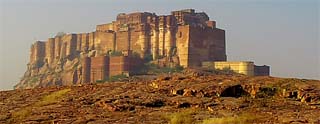 What ever way you might have arrived at Jodhpur, from any location you can see this magnificent fort within the Jodhpur city. This biggest fort of Rajasthan is located at the top of a hill of 150m hieght and from railway station this is the first structure which attracts tourists.
 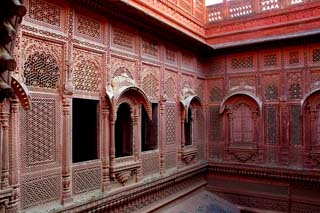 The main entrance to the fort is known as Jaipol ( Victory gate ). This gate was constructed by Maharaja Man Singh to commemorate the victory over Maharaja Jagat Singh of Jaipur. Jaipur king attacked Jodhpur in 1808 AD and Jodhpur city was captured by the Jaipur army. A tough fight took place to capture the Jodhpur fort and cannon were fired. The cannon marks are still visible on the walls of the fort. At the end Jaipur army ultimately fled.
 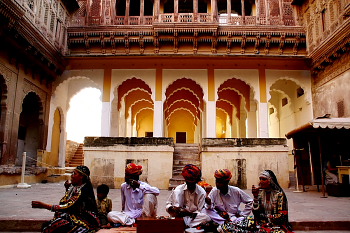 This fort was constructed in the year 1459 by Rao Jodha. Fort is named after a Rajasthan tribe known as Mehrans. Jai Pol is the main entrance of the fort. From the fort Jodhpur city is visible with its unique blue color. Originaly the blue color was used by the Rajpurohit and Brahmins so the king can easily identify their houses from the fort. From the fort at a distance Umaid Bhawan Palace the present residence of erstwhile king is visible.
 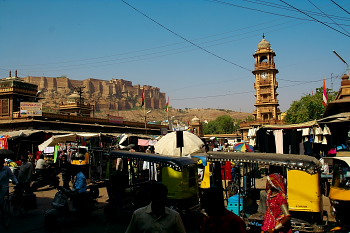 This is a busy and second biggest city of Rajasthan after Jaipur. With crowded roads and big buildings this city is known as blue city of Rajasthan. ( Jaipur is pink city and Jaisalmer is golden city ) Nai Sarak is the busiest road and many big and small shops are available here. Jodhpur is one of the popular destination for shopping. Traditional Rajasthani dresses are available at a very attractive price in Govt Emporium at Nai Sarak road. For other textile items you can bargain for your best price. Jodpur is famous for its Jodhpuri dress, it is a full dress with rounded neck and hand work embroidered on it. Price varies on cloth and type of design on the dress. Another shopping center for textile is Tripolli market. At one end of the Nai Sarak is famous Clock Tower or Ghanta Ghar. This tower is illuminated by different color of lights in the evening. Around the clock tower there is a big local market selling traditional items like bangles, shares, Chunny, utensils are some of the popular products sold here. One of the famous drink of Rajasthan is Lassi. This drink is available through out the state but the Lassi of Jodhpur near the clock tower is very famous. You have to use a spoon to drink Lassi here, where as Lassi is taken as a drink by use of a straw in all other parts of the country.
 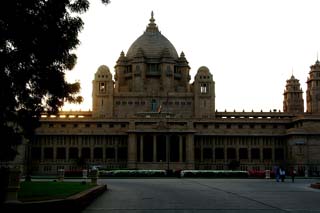 This Palace is the present residence of erstwhile royal family of Jodhpur. This palace is constructed by Umaid Singh the King of Jodhpur in 1920. Today part of the palace is used as museum for the tourist to visit. Central part is maintained by Taj group as a hotel and in other part the present king and his family stays. Entry is allowed to the museum only and tourists are not allowed to enter to hotel or to the private area. Hotel entry fee can be paid and it will adjusted against drinks and foods server in hotel.
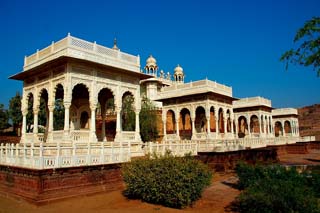 This was constructed by Sardar Singhji in memory of his father Jaswant Singhji . This is a beautiful Marble cenotaph surrounded by garden and a small pound. Jaswant Singhji was burn in 7th Oct 1837 ( Saturday ) and breathed his last on the 11th October 1895. To his credit he has introduced Railway, post offices, telegraphs , opened schools, hospitals, colleges and constructed Bundhs