Showing posts with label Fort. Show all posts

Friday, 19 August 2011

Around Tirupati - Chandragiri

On our ten day Tirupati visit, we visited temples galore, waterfalls, museums, a zoo and even a science centre! The last place we visited was a fort, to round it off, so to speak! I would call the Chandragiri fort more of a palace than a fort, and that too, a rather simple palace, on the whole.

Layout of the Chandragiri Fort

According to Wikipedia, Chandragiri was built by the Yadava Rayas in the 11th century, and they ruled it for over three centuries. It then came under the control of the Vijayanagara rulers, who moved here when the Golconda attacked their capital at Penukonda. It was annexed by the Golconda sultans in 1646, and finally came under the rule of the kings of Mysore. Around the end of the eighteenth century, the fort was abandoned, and it sunk into oblivion.
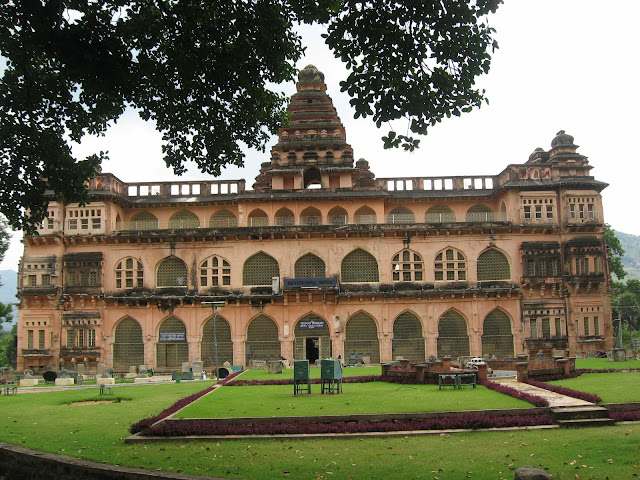
Raja Mahal

The main structure here is the Raja Mahal, literally the king’s palace. Compared to some other palaces I have seen, this was quite simple, and is now used as a museum, housing various artifacts found in the fort as well as the surrounding areas. As usual, Samhith and I were drawn towards the various models of temples, forts and museums, which is what I shall always remember. We especially loved the model of the Gudimallam temple and lingam, as well as the model of the entire Chandragiri fort.


The only other structure in this complex is the Rani Mahal, the queen’s palace, which was even simpler than the Raja Mahal, so we just had a look from outside. Apart from this, there are only huge lawns where the crowds come to have a picnic and a too small lake where people go boating. Of course, Samhith wanted to go boating at once, but the lake was so small, that I was afraid we would get dizzy, and stayed away from it!


The fort complex is maintained by the ASI, which has done a pretty good job of popularizing the places it maintains by putting up huge boards, but none of the staff have any information about the places they are (supposedly) popularizing! Neither do any of them have any information, but the ASI book store has books about all kinds of places, except this one or the locations mentioned on the boards! It’s a pity to see the people who are in charge of our historic monuments.


Rani Mahal

More interesting was the drive through the narrow lanes of the erstwhile fort, along the remnants of the outer and inner walls. There are a few temples around, which were once inside the fort, but there is just one where prayers are still conducted, and it was closed. It was fun, though, to listen to our auto driver who acted as our guide and described how traitors were taken up to the peak of the hill and then thrown down from there… that triggered off Samhith’s imagination, which turned out to be not-so-funny after all! There are a few people who trek up the hill… that must be interesting, I felt, but since I am not the trekking kind, it is something I have to wait for someone else to try and write about…so that I can experience it second-hand!
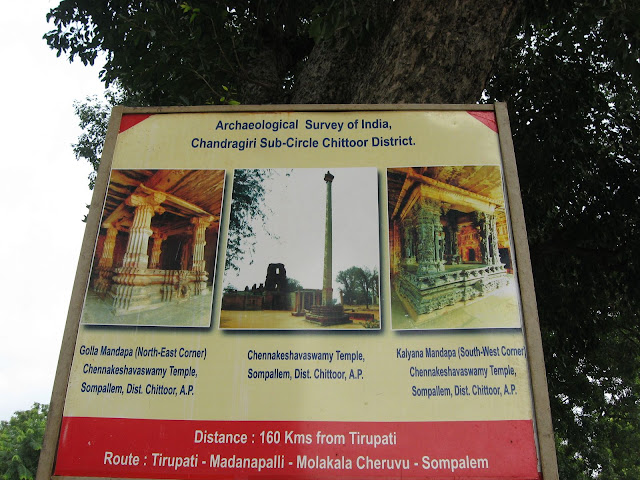
ASI Board about other monuments

Incidentally, the second walking path to Tirumala – the Srivari Mettu – starts near the fort. Again, from what the driver told us, the path was made for the royal family to visit the temple, a kind of private walkway!

Here are some more images of the fort and its surroundings.....

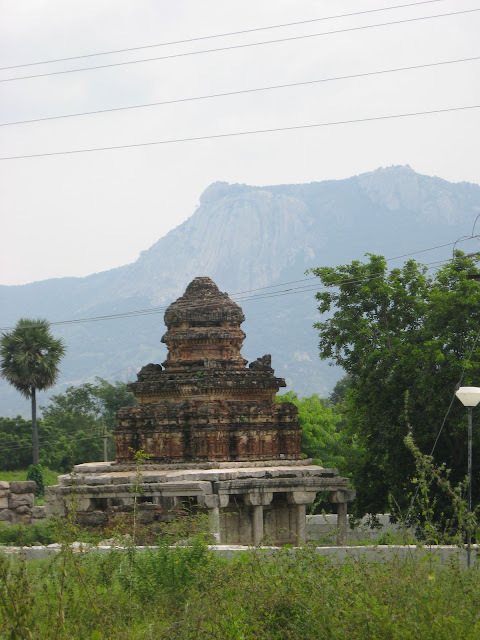
A dilapidated temple..........

One of the gates - the inner wall, with a rickshaw coming through......


The same, by itself... which pic is better????


One of the hills with some structures atop it.....


The source of our driver's stories - it does look like the kind of place people would be pushed from.. don't you think so?
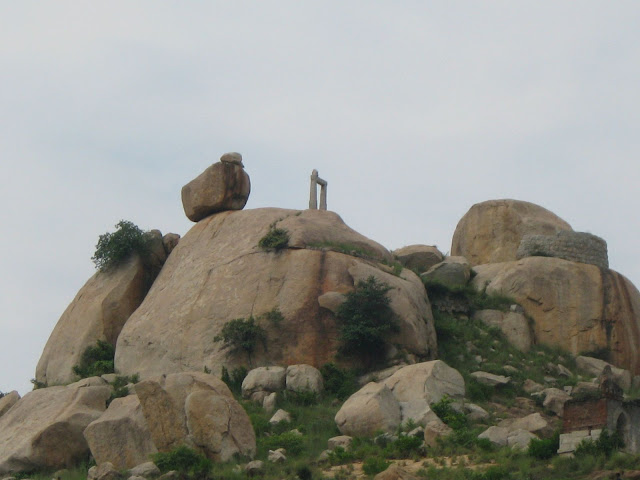

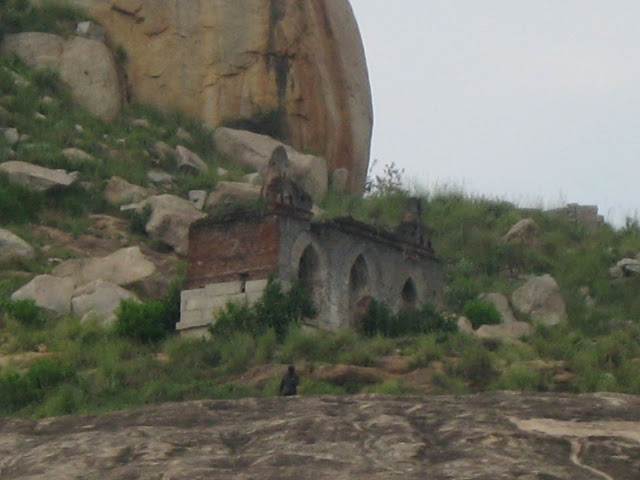
Another structure... there are steps to reach this place! See, there is a person up there!

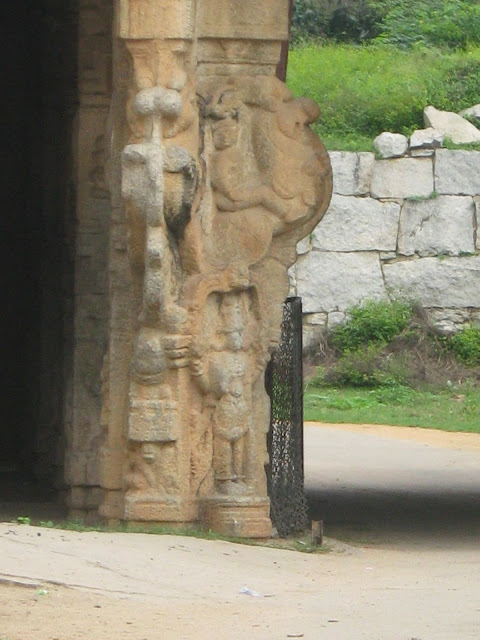
Another gate - this time the outer wall.


A close-up..


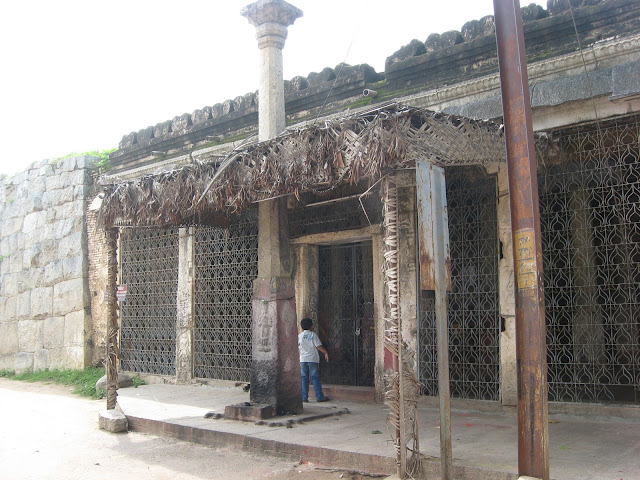
Samhith peeping though the closed temple....


Information:


Chandragiri fort is about 12 Km from Tirupati, from where frequent buses are available.


There is a sound and light show every evening, from 6:30 PM  to 7:15 PM in Telugu and from 7:30 PM to 8:15 PM in English. The charge is Rs. 30 for adults and Rs. 20 for children.

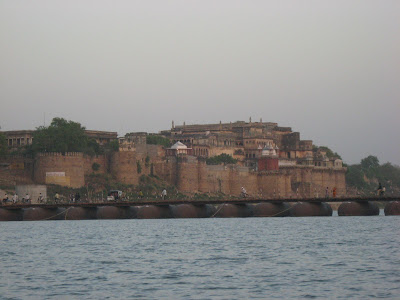
The Ramnagar fort and Palace

Kashi might be the abode of the gods, but it also been ruled by various kings, who left their imprint on the city. The Raja Ghat on the river, for example, was built by one of them, and history tells us that one of the kings actually jumped from one of its high turrets while trying to escape the British troops during the mutiny, and actually succeeded!


Our first view of the Ramnagar Fort from the boat
The last remnant memory of the kings of Benares is the Ramnagar Fort and Palace on the opposite banks of the Ganga, in a section of which the present scion of the royal family still resides. The palace is about 15Kms away by road, and an auto takes about half an hour to reach there. We however chose the longer, but more interesting and relaxing option- that of taking a row boat to the palace across the river. The journey took us a good one and a half hours, but the sheer bliss we experienced made every minute worth it!


The palace has now been converted into a museum, which closes around 4:30PM. If you want to have a leisurely stroll among the various antiquities displayed, make sure you keep at least 2 hours for the palace alone.


The entrance to the fort- the Lal Darwaza

The Legends that surround Kumbhalgarh

History or Legend? Sometimes it is difficult to choose the right word. Here, I chose to use the word ‘Legend’, as I have not been able to verify the authenticity of the stories I heard from an old man living in the Kumbhalgarh Fort. He told us that he was a native of Kumbhalgarh, and had also worked for the Archaeological department in the fort, lending a touch of credibility to the story he told us. I must admit, that though we have fallen into the habit of taking in stories with a pinch of salt, there was an air of truth about this man.


A Miniature of Rana Kumbha from Chittorgarh

To begin with the origin of the fort, it is indeed a fact that the original fort here was ruled by the Jain king Samprati, who built around 300 Jain temples inside the fort. After him, the fort remained unused, and fell to ruins, except the temples, which survived to tell their story. Rana Kumbha came here to build a fort so that he could defend Mewar against the Mughals who were regularly attacking Chittorgarh. He decided to build the fort a little lower down the mountain, where there is a lake now, and started construction. The story goes that the men would build all day long, and retire late at night. When they woke the next day, whatever they had built would have crumbled. This continued for quite a few days until finally, the Maharana consulted his Guru, who came from the ‘Mér’ family of seers. The guru told him that it was a divine hand that was doing this, as he wasn’t fated to build a fort at that place. He further told him that he would show him the place where the fort was to be built, but the place demanded a voluntary sacrifice from a man who would agree to lay down his life for the king. When the king couldn’t find such a person, the guru volunteered his own life, under one condition- “the fort should bear his name.”
Needless to say, the king agreed. The Guru led the king up the mountain, where the fort now stands, and told him to cut off his head. The place where the head fell would be the main entrance of the fort, and where the body fell would be the palace. The king did as he was told. The guru’s head fell at a point where the Bhairon Pol stands today, and to the great surprise of everybody, the headless body walked a further kilometer up the mountain and finally fell right at the top, where the palace was later built. This is a wonderful story, which gains authenticity when I add that just past the Bhairon Pol , there is a small temple-like structure, which has a stone covered with sindoor ( a red powder), which we were told was done to mark the place where the great saint sacrificed his life for his king. The fort was named 'KumbhalMer', after the king, as well ashis guru. It was only later that the name 'Kumbhalgarh', or 'fort of Kumbha' became famous. However, this story finds no mention in a book that I bought about the history of Kumbhalgarh.

Maharana Kumbha not only built the fort, the palace and 60 Hindu temples, he apparently took great care of the Jain temples too. The main Hindu temple that he built was that of his chosen God, Neelkanth Mahadeo. It is said that Rana Kumbha was an extraordinarily tall man, who, when he sat, came up to the height of the Shivaling (5 feet), and could encircle the lingam with his hands. This seems a trifle exaggerated, but then, one never knows, besides, it is possible that with the headgear and the kind of clothes they wore, he could possibly have appeared as tall as 9 feet, which was the height we were told he was.
In any case, it is another fact that it was when he was worshipping this Lingam, that he was stabbed to death by his own son, Uda Singh, who was the father of Maharana Pratap.
Quite a sensational story, is it not?

Now here’s another story, which finds no mention in history books, but is interesting enough to be written down.
Maharana Kumbha had started a system of lighting a huge lamp, with 100meaures of oil, and a wick made with 50 measures of cotton (I am not mentioning the measures, as the ones told to us were in the local tongue, and didn’t make much sense to me). The light from this lamp was bright enough for the farmers of Marwar to work during the night, and was seen as far away as Jodhpur. The queen of Jodhpur, known as the Jhali Rani, saw the lamp and appreciated the king who cared so much about his subjects. The king didn’t like such praise of another king, and banished the queen telling her to go to the one she appreciated so much. Left with no choice, the queen started for Kumbhalgarh, and sent a message to Rana Kumbha explaining her situation. The Maharana welcomed her as a sister, and gave her a palace to live in, without any slur being made on her reputation. This is the palace where there is a Durga temple, and the palace is called ‘the palace of the Jhali Rani’, after her. When her husband came to know of this, he marched with an army towards the fort, intending to take her back by force. He approached the fort from the rear, passing through thick jungles which are today, part of the sanctuary. He found it extremely difficult to move through the forest. He had to cut down trees to make way for his armyKumbha advising him not to use force, and stealthy means, and that he would get what was d, and the trees seemed to grow faster than he could cut them. At last, a message arrived from Rana ue to him if he approached with humility. The Jodhpur king realized his folly, and asked permission to come to Kumbhalgarh. Rana Kumbha welcomed him with full honours from the Victory gate, and treated him as he would treat a son-in-law. (In India, a son-in-law is treated with even more respect than one would treat an equal). The king stayed at the fort for a few days, and took his queen back with him. When he returned, Rana Kumbha felt that, as he had considered him a son-in-law, he must give him ‘dahej’ or dowry when he returned, and gifted him the whole area of Marwar from Kumbhalgarh to Falna. Such was the large heartedness of this great man!

Another legend that surrounds Rana Kumbha is the story of Muchhal Mahavir. The Muchhal Mahavir Temple
Muchhal Mahavir is a Jain temple dedicated to Lord Mahavir, at Ghanerao, which is on the route from Falna to Kumbhalgarh. This temple too has its origin long before Rana Kumbha came on the scene. The story goes that once, when the Rana was on a hunt, he came to the temple where he was offered refreshment by the priest. The priest offered him the Prasad of the Lord, and the Rana was amused to find a strand of white hair in the Prasad, which must have fallen from the priest’s head. As a joke, the Rana asked the priest “what! Does your Lord have a moustache?” the scared priest, without realizing what he was saying, replied in the affirmative. Carrying the joke further, the Rana refused to pay his respects to the Lord that day, and told the priest that he would return after 3 days, and wanted to see the moustache of the lord! The priest didn’t know what to do and spent the next two days in prayer. When he did not see any results, he decided to commit suicide rather than be killed by the king. When he picked up the dagger of Bhairon at the temple to kill himself, the Lord appeared before him and advised him to cover the face of the idol with a piece of cloth and ask the king to remove the cloth himself after offering prayers. When the king arrived the next day, the priest welcomed him warmly and asked the king to have a bath and offer prayers to the Lord himself. Seeing the cloth covering the face of the idol, the king got angry and demanded an explanation. The priest repeated to the king what he had been ordered to do by the Lord. The king agreed and offered his prayers to the Lord, and when he opened the cloth, Lo and Behold! The idol of Mahavir not only had moustaches, but also a beard!! The king repented for having made such a joke and asked forgiveness from the priest. He was, needless to say, forgiven, and the beard and moustache disappeared. But the name has stuck. The Lord has, since then, been called ‘Mucchal Mahavir’, or the Mahavir who had a moustache.

Kumbhalgarh - A glimpse into the past

Nestled among the mighty Aravallis are many forts of the Rajputs, each one greater than the other, each one relating a story of its own, a story which is part history, part legend, but which gives each of these forts its own unique identity. The Kumbhalgarh fort in Rajasmand district of Rajasthan is one such fort which has its own story to tell.

Kumbhalgarh Fort

Kumbhalgarh is about 90 km from both, Udaipur as well as Falna. We took the Ranakpur express from Mumbai to Falna, and a cab from the Falna station to Kumbhalgarh. The 2 ½ hours drive took us through lush green fields and rocky mountains welcoming us to a part of Rajasthan we had never seen before.


Our destination was the Club Mahindra Resort, 5 Km from the fort. The other options for accommodation near the fort are ‘The Aodhi’, a favorite with foreign tourists, ‘The Dera Tented Resort’, which offers variety and adventure in the form of luxurious tents, the ‘Kumbhal Castle’, and the ‘Tiger Valley Resort’.

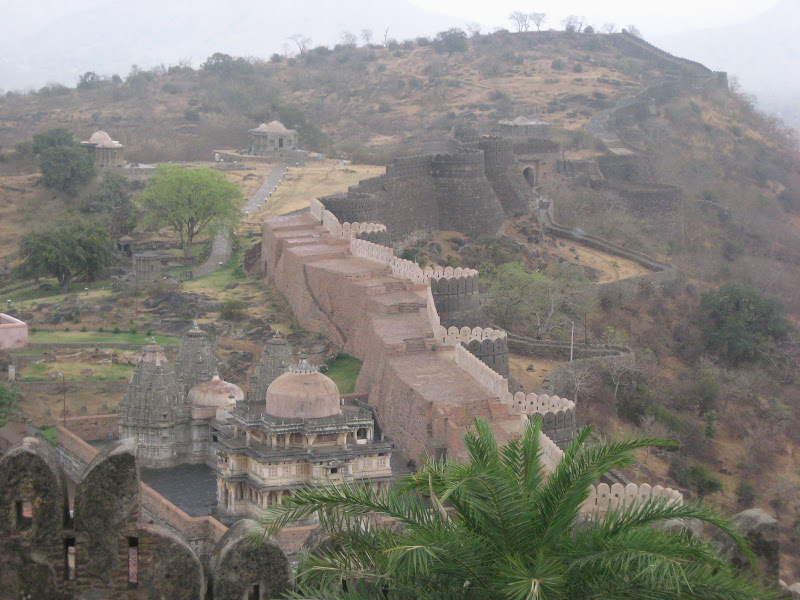
A View of the wall of Kumbhalgarh Fort
The Kumbhalgarh fort was built by Rana Kumbha to defend his kingdom from the Mughal invaders, and the USP of the fort is its 36 km – long wall, said to be the second largest after the Great Wall of China. However, the fort wasn’t the first structure to be built at this place. In ancient times, it was the capital of a Jain king, who built about 300 temples at this place. Rana Kumbha added to this and at the peak of its fame, the fort had a total of 360 temples within its walls, 300 of Jains, and 60 of Hindu gods. Today, few of these are left, fewer with idols inside. Of these, the Neelkanth Mahadeo Temple has pride of place, having been the chosen deity of Rana Kumbha. The 5 feet high Shivaling in this temple was personally cared for by the king who, it is said, towered over the lingam at 8 feet. Ironically, it was while he was praying to this idol that he was stabbed in the back by his own son, who, again ironically, was the father of the great Maharana Pratap.

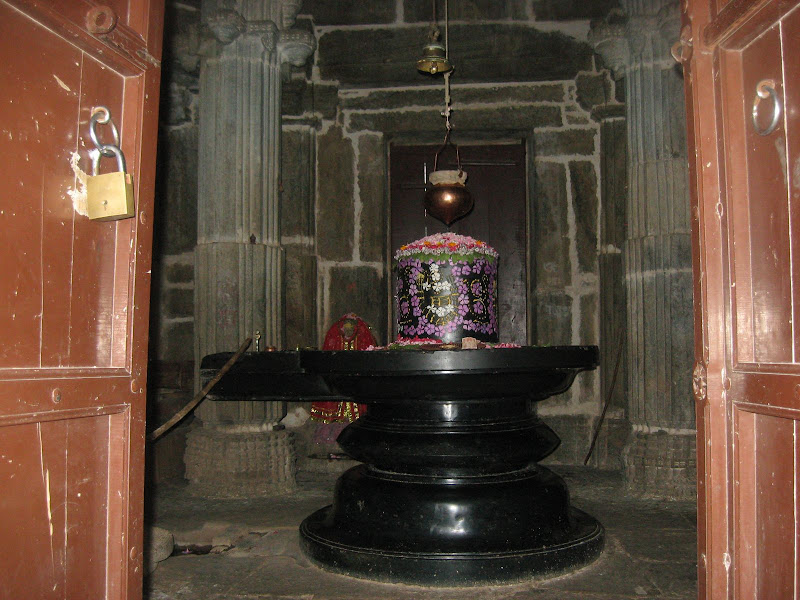
The idol of Neelkanth Mahadeo


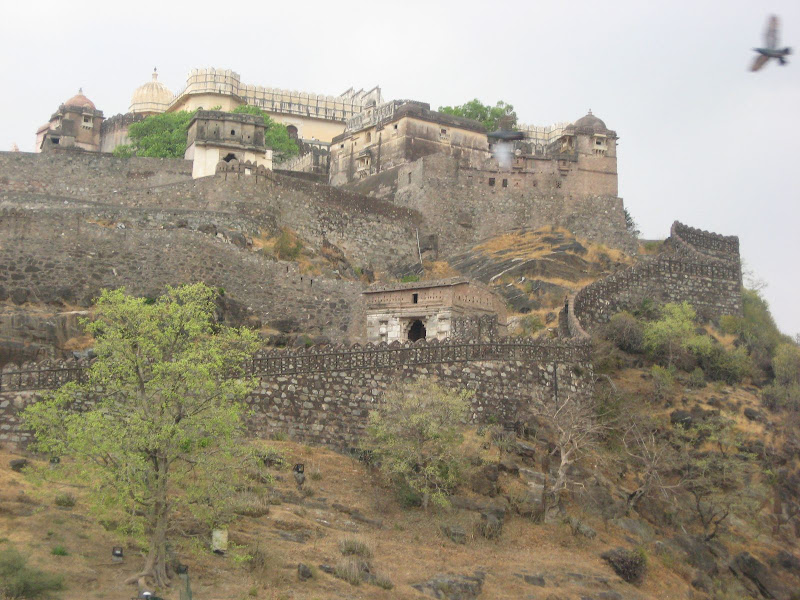
The fort itself is very impressive, and one can spend hours roaming over the vast area, if only there was someone to guide us. As it is, the only effort the government is making to popularize the fort is in the form of a sound and light show, as part of which, the fort is lit up every evening between 7:30 and 8:00PM. This is really a very beautiful sight, one which every visitor must look forward to. The palace, at the highest point of the fort is however, not all that impressive, or rather, unlike what one expects of a Rajasthan Palace. This palace, in fact, is the birthplace of Maharana Pratap, and deserves a lot more care and maintenance.

A View of the Palace

Rana Kumbha was well known, not only for his valour, but also for his large-heartedness, his generosity, as well as righteousness. Kumbhalgarh abounds with legends connected to him, and when one hears these legends from the mouths of the locals who make up for the scarcity of guides, one can actually imagine the great man who made this difficult terrain his home, and feel his presence lingering around……

Rana Kumbha

There are quite a lot of places to visit around Kumbhalgarh-

The Kumbhalgarh Wildlife Sanctuary (5 Km) – The Jungle safari is a must for nature lovers. Don’t have great expectations with regard to animals, and you won’t be disappointed.


The Parshuram Mahadeo Temple (20Kms) – A Cave temple approachable from Falna as well as Kumbhalgarh, it involves a 1 ¼ Km trek to the cave where Lord Shiva blessed Sage Parshuram. Water permanently trickling down on a natural Shivaling is a wonder of nature. This temple is a must-visit for those who are spiritually inclined, as well as those who aren’t.


The Ranakpur Jain Temples (50 Kms) - Architectural wonders!


Mucchal Mahavir (25Kms) – Jain temple

Ganesh Temple (Ghanerao) (25Kms) – Life-size statues of Lord Ganesha and his consorts Riddhi and Siddhi.


Haldighati (25 Km), Nathdwara (50 Km), and Udaipur (90 Km) are also easily accessible from Kumbhalgarh.


Kumbhalgarh Trip- Day2- The Kumbhalgarh Fort

We spent the first day at the resort catching up on sleep, and the second morning passed by just getting acquainted with the resort. I was looking forward to going to the fort soon. We had been told that the best time to visit it would be in the evening, as the fort would be lit up around 7 P.M. We left the resort around 4 P.M. so that we could take in the sights before it got dark, and then wait until the lights were switched on. The weather had been pleasant since our arrival, which in itself was surprising. We had expected it to be quite hot, and packed in all our summer things. It turned out to be quite cool up there, and that evening it was also a bit cloudy.


Our first view of the Kumbhalgarh fort

The Kumbhalgarh fort is an impressive edifice that remains hidden from view till the last bend in the road, less than a kilometer away. It is only after we enter the first gate of the fort, and the road turns towards the fort, that we can get our first glimpse of the fort and its famous wall.


The first gate of the fort

The driver of our vehicle stopped at the main entrance, where we had to buy a ticket for entering the fort, and told us to just follow the road to the left. Right at the entrance was a temple to Lord Ganesh.

The Ganesh Temple

We had scarcely set foot inside the fort that it started raining!!! It wasn’t a very heavy rain, but at that height, along with the strong wind, it was quite an experience, climbing up the steep path to the palace at the top of the fort in the pouring rain. I have always enjoyed getting wet in the rain, and it was a pleasure to get soaked at such an altitude. Even more than that, it was good to see that Samhith too enjoyed the rain, and made the most of it. He ran on, ahead of us until I scolded him and made him hold one of our hands. The wind was so strong, and the path so steep, I was afraid of him falling down, but thank goodness, nothing of the kind happened!


We walked along, enjoying the view, and appreciating the way the fort and palace had been built. There was a sign right at the top, pointing out the place Maharana Pratap had been born, and we expected someone to be there , someone who would tell us the story of the fort, but everything was securely locked, and there seemed no sign of life anywhere around. It was only after we tried out another path to the palace that we found one, single door open, and a watchman, who wasn’t too interested in talking to tourists. There were a couple of other families there, also from our resort, who seemed to be a little more informed about the fort than we were, so after a round of the palace, and a small temple of Durga Maa inside a smaller palace, we turned our steps downwards, towards the temples we could see at the ground level.


Inside the palace


The Durga Temple inside the palace

The first two temples that we saw were closed, and we were told that there were no idols inside. So, we turned towards the wall which had been beckoning us ever since we entered. There are points all along the wall (on the inside, of course), where one can climb up to the wall, but only some are in good condition. We used one of these to get up there, and it really was awesome! We had heard that the wall was broad enough for four horses to move along at the same time, but up close, it looked even broader. Four horses wouldn’t have had to move very close to each other at any point on the wall!!!


The wall, we learnt, had been built over a period of 14 years, and was about 36 Km long! The men must have been skillful indeed to have built such a masterpiece which has survived centuries, and still is in such good shape. I can’t imagine a building of today surviving even a fraction of the period, when subjected to the vagaries of nature, as this one would have faced!!! The wall apparently is in good condition all over, except one section, which crumbled recently. But here, it must be mentioned, that there is a serious lack of interest displayed by the authorities here. It is true that over the past few years, the government has tried to restore the palace, temples, and fort, and make it a tourist attraction, (the evening lighting, and a proposed sound and light show are efforts which the govt. is making in this direction), but much more can be done. For example, it is only part of the wall that has been cleaned, making it possible to walk on it. The rest of the wall lies in disrepair. When we asked if it was possible to walk all along the wall, we were met by stares, rather than answers. It is a matter of great pride that we have places like this in our country, but we need to make a lot more effort to maintain them, and make them attractive enough to draw more people towards them. It might not be possible for people to walk the entire length of the wall, but I am sure there are more people like me out there, who would like to make more trips to different sections of the wall, and visit the other temples which are inside the fort complex, but much farther away.


A View of the Palace from the wall

Talking of temples, it seems there are 360 temples inside the fort, of which 60 are Hindu temples, built by Maharana Kumbha, while 300 are Jain temples, which date back to the 6th or 7th century, when the Jain king, Samprati ruled over this place. Most of these temples are in ruins and only a few have idols now. Of these, the most important one is the Neelkanth Mahadeo Temple, the chosen deity of Maharana Kumbha and his family.


The main Shivaling, Neelkanth Mahadeo, is an impressive one, being about 5 Feet in height. It was here that we found an old man, who, when asked, happily recounted to us the story of this impressive fort.

Meanwhile, let me move on ……. After we spent some time at the temple enjoying the view, and thrilled to see a peacock, we headed back to the wall to see the lighting. The lights are put on every evening at 7:30P.M. for about 20 minutes, and it is, indeed an awesome sight. The fort glows gold against the black colour of the night, and one can just sit there for hours in the cool breeze, drinking in the sight. However, hours is what we don’t have, for we have to climb down the wall before the lights go off, and everything is black, so we hurried down back to the car, and on out return journey, managed to get a few photos of the fort while lit up.


This ended our jaunt to the fort, which is undoubtedly, one of the most impressive that I have ever seen. One of our fellow travelers from the resort told us that the Chittorgarh Fort is the best in the whole of the Mewar area of Rajasthan, even better than this one, but I can’t comment until I have actually seen it. Las year, we had visited Jodhpur and Jaisalmer, and though Mehrangarh Fort in Jodhpur is undoubtedly maintained much better, and the Jaisalmer fort is unique as the only fort in which people still live, this one has been much more impressive. It is here that one can actually imagine and feel the life that the Rajputs led- their valour, their pride and their greatness!