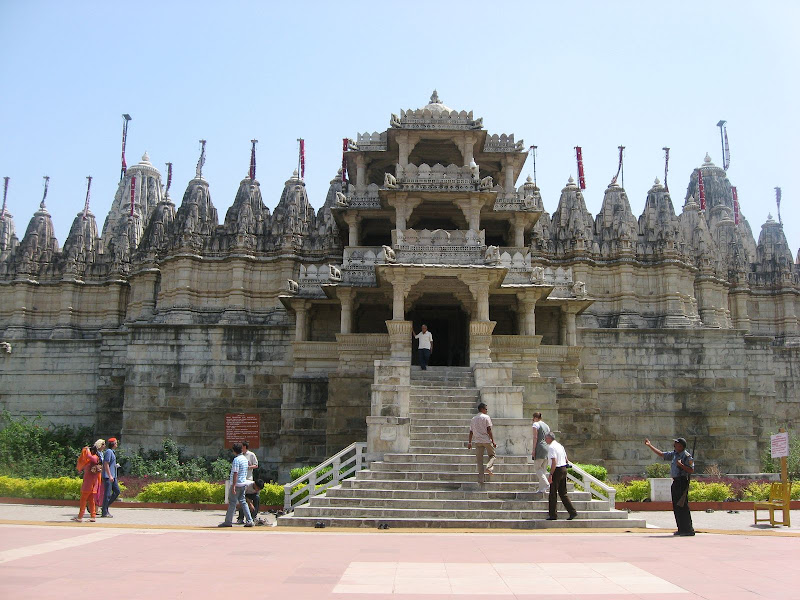
Showing posts with label vacation. Show all posts

Friday, 19 August 2011

Magnificent Munnar – Part II - A day in the hills

Munnar has enough magic keep one enthralled for at least 3 days. There are a number of places to see and lots of trekking routes to explore in all the four directions. We however had only a day with us, and had to make the most of it. We decided to take the route which would take us to the dams and lakes where we could spend the day boating, which Samhith enjoys immensely. As it happened, most other tourists seemed to have had the same thought, and every boating pier was full, and we had to return without a single boat ride. We had lots of fun in other ways though, but let us take things in sequence.
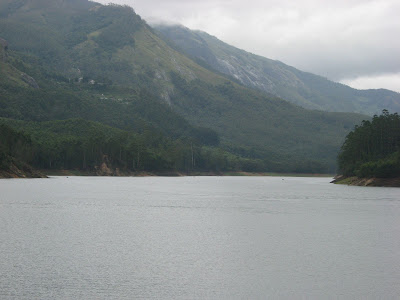

The View From Mattupatti Dam

We started for Mattupatti Dam, about 12 Kms away. Here, in the lake created by the dam, one can ride speedboats. However, the speedboats were few, and tourists too many, and we were told that we would have to wait for at least an hour. None of us is known for our patience, and we decided to move on, albeit with some reluctance. Outside the boathouse, we found lots to occupy us though- there were the usual stalls selling wooden articles, food, and of course, games. Sankar tried his hand at shooting balloons, while Samhith collected them, and we spent more than half an hour whiling away our time. The best part here was the elephants, whom we could feed a basket of fruits, and climb on for a ride. We did both, Shankar feeding an elephant, and Sankar, Sandhya and Samhith going for an elephant ride.
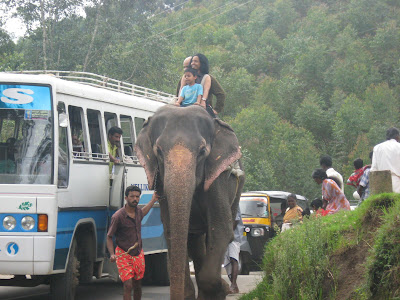

Sankar, Sandhya and Samhith go for an elephant ride

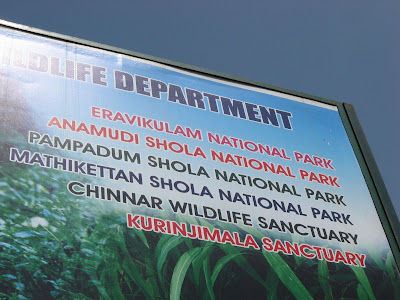
We then moved on further, intending to visit Top Station (34Kms from the town), from where one could get a birds eye view of Tamilnadu. We were almost there, when we stopped for tea at a small stall by the roadside. The road forked there, one going towards Top Station, just a few minutes away, and the other towards one of the wildlife sanctuaries. (Incidentally, there are no less than 6 wildlife sanctuaries around Munnar – see the photo of the banner listing them).


We had now to decide what we wanted to see more – the jungle or the view. Samhith saw a calf tied to a pole there, and he found that more interesting than anything he had seen so far. His decision made, he went off to play with the calf while I wandered away with Sandhya, trying to find a washroom. It turned out that the nearest one was at Top Station, and we walked all the way, stopping to appreciate the riot of colours in the form of flowers surrounding us. After that, the view from Top Station was disappointing, to say the least. We decided to head towards the forest. Meanwhile, our husbands had spoken to the locals hanging out at the tea stall, and had decided that the excursion into the forest was a waste of time, as the calf my son was playing with was in all likelihood, the only animal we would come across. So there we were, turning back from the highest point in Munnar, retracing our route back to the lodge.

Samhith Plays with a calf at Top Station


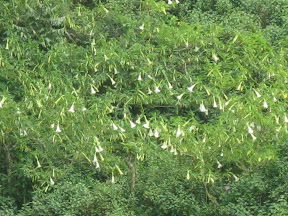
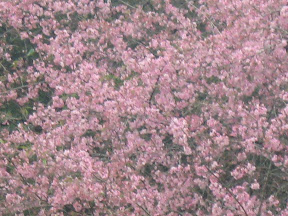
A Riot of Colours
Our first stop on the way back was at the Kundala Dam. We had passed it on our way up the hill, but had decided not to stop. Now however, we decided to see what attractions it had to offer. This is a good place for a picnic, for the river bank is a vast expanse of green velvet-like grass, with facilities like boating (Pedal boats, row boats and Shikaras) and horse riding available.
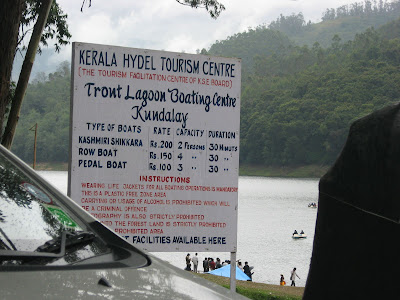
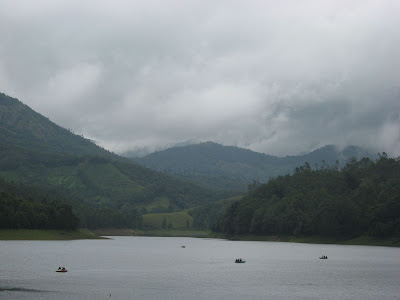


Boating on Kundalay Dam

It is the ideal place to visit as a group, and I wished I could just sit on the river bank and watch others play. In fact, the place was full of people who had come from schools and colleges, equipped with bats and balls, racquets and shuttlecocks. The rain however arrived to play havoc on their well laid plans, and we all rushed to the few sheltered areas available in the form of small hut-like structures.


Samhith joins a group of youngsters for a game...

Here again, the boats were all booked, and there was a long line of people waiting. Again, we dropped the idea of boating and instead opted for a horse ride to make up for Samhith’s disappointment.
Sandhya and Samhith go on a horse ride
We then started back home, wondering whether to take a look at the few places left or head back to the room and take some rest. Over a hot cup of tea and steaming hot Onion and Potato pakodas, we decided to try out the Attukal Waterfalls, which, we learnt would be on the route back to our lodge. This decision led to the best time I have ever had in my life. Indeed, it must have been Lady Luck who made this decision for us!


The Attukal falls seen from a distance
We were about 5 Kms from Attukal when the weather started changing. It began with a slight chill in the air, and then a slight drizzle. Soon, before we even realised it, the visibility started reducing by inches, and we were surrounded by a curtain of thick fog. None of us had seen anything like it, and we were all enthralled by the sight! I wore out my poor camera clicking photos left right and centre!
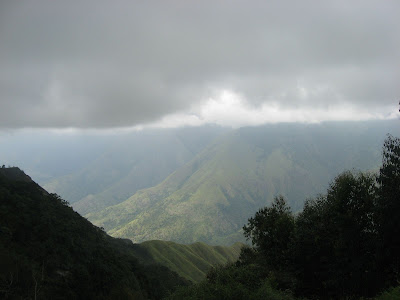

Gathering clouds indicate the changing weather....
We found the turning to Attukal from the main road, from where the falls were about a kilometre away, and took the turn, determined to see at least one place properly in Munnar. The road led through the tea estates belonging to Tata Tea, and was edged by tea plantations on all sides. We however, could only get a glimpse of the vast carpet of tea leaves due to the fog. All our attention was on the road, which was hardly visible. Sankar, driving his huge car, had the toughest job of all, looking at the road ahead, navigating the sharp curves of the road, and also keeping an eye on the deep valleys on both sides. He said, later that the most difficult things about the drive was the knowledge that we were all sitting with him the car, and even a small error would prove to be fatal!
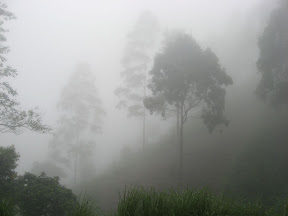
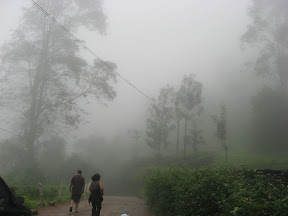
Pictures of the Fog...

The sound of rushing water alerted us to the nearness of the waterfalls, and suddenly the falls themselves appeared out of the fog. The sight of water rushing with such force is unnerving, to say the least. I have never seen a sight like that before, and the memory shall stay with me forever. There is a small bridge on the stream from where one can get the best view of the falls. Here, one is very conscious of the sheer force with which the water flows, and even a wrong step could spell doom.
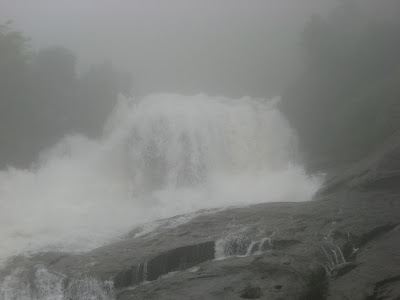

The Attukkal Falls


All of us at the Attukal Falls

There is a small shack, or rather a house where one can get tea and snacks, while watching the falls from a safe distance. We spent some time walking around the place, getting a feel of the falls, but decided to get back as soon as possible, as the fog was getting denser. The return journey was as thrilling as the arrival, but we reached our lodge safe and sound, too early for dinner, but in no mood to sit in the room after such a wonderful adventure.
The restaurant at the Attukkal Falls

We had decided to have dinner at the Whispering Meadows resort about a kilometre away, and to while away the time, decided to take a walk. What was planned as a short walk up to Whispering Meadows turned out be a one and a half hour walk, going beyond the resort, and turning back when it began to rain. Finishing our walk in the rain, with the fog getting steadily thicker, was an adventure in itself, one I wouldn’t trade for anything! Once we were through the excellent dinner at the resort, we had no more energy to walk back, and hired a vehicle from the resort back to our room.


On the road, in the fog....

Thus we called an end to a day that began like a typical day at a hill station visiting the various points, and ended with an experience more like an adventure, one that all of us will always remember.

Magnificent Munnar - Part I - Arrival

Munnar is one of the most beautiful hill stations of our country, one which makes the appellation of Kerala as ‘God’s own country’ come true. It is a land of mountains covered in every shade of green imaginable and unimaginable; of tea plantations which stretch over miles and miles of countryside, not sparing an inch of the mountains; of waterfalls which cascade down the mountains, their origins too high to be seen, their final destination unknown, but their force increasing by leaps and bounds of the water……. The beauties of Munnar are to be experienced, not enumerated. But the memory I shall always carry with me of this magical place is the fog - The fog which made the road ahead practically invisible; the fog which appeared out of nowhere, bringing with it the chill and the monsoon rain. But before I get carried away, I must begin at the beginning.
The beginning was early in the morning on the 15th of August, our Independence Day, when we left our cosy beds to catch the first flight to Coimbatore. We reached my sister-in-law’s place at Tiruppur for lunch, and soon we had decided to leave for Munnar. Never mind that we had no hotel reservations and it would be terribly crowded, being a long weekend. My husband and brother-in-law are great optimists (they share quite a lot besides their names- my husband is Shankar while my brother-in-law is Sankar) and they were sure we would manage to get a place to spend the night, and that too, comfortably.


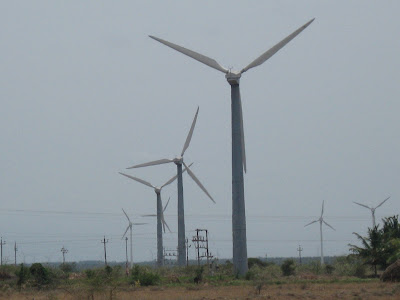
Windmills along the route


Well, to cut things short, we were off in Sankar’s new Hyundai Sonata Gold, on our way to Munnar. The distance from Tiruppur to Munnar is about 150Kms, and along the way, our first stop was at the Amaravathi Dam. The Amaravathi River is responsible for the lush greenery in this part of Tamilnadu, mainly Udumalaipettai and the surrounding areas. My father’s ancestors hail from this part of the country, their village being one of the so-called 7K villages (all seven names beginning from K) known for their fertile lands, all on the banks of the sacred Amaravathi. In fact, our ancestral temple also stands on the banks of the river, but that is another story, one which I shall relate some other time…….


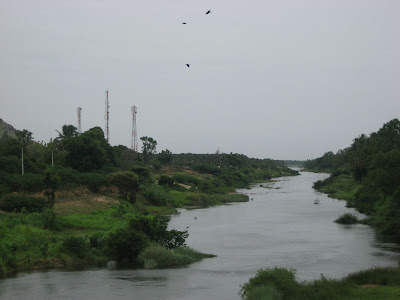
The Amaravathi River near the Dam at Amaravathi Nagar


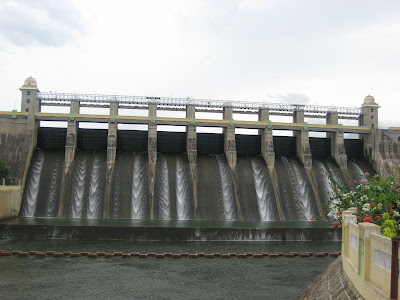
The Amaravathi dam

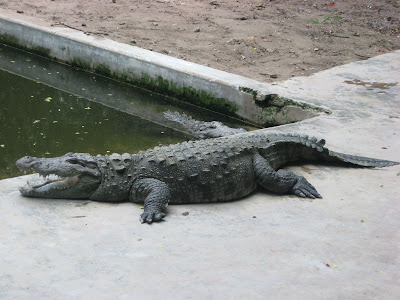
The rain gods had been generous lately, and the Amaravathi dam was full, and a sight to be seen. The water from the dam falling into the river, the canal full of water, into which children happily dived and swam - all this was a wonderful sight. But what my son Samhith really enjoyed was the Crocodile Park. Yes, there is a crocodile park, about a kilometre from the dam, where crocs are reared and taken care of. To give them credit, the park is full of crocs, big and small. There are Magars (Crocs) and Gharials, which are only found in the Gangetic rivers, and are easily recognised by their characteristic long snout (or mouth). But it is sad to see the condition of the pools of water that are supposed to constitute their natural habitat. All the crocs were fast asleep and were least interested in waking up. Somehow even their lethargy attracted Samhith, who wanted to know if they would at least wake up to eat!


A Corcodile sleeps with his mouth wide open


Baby Crocs in the Corocodile Park


After we passed the dam, things began to get more interesting as we entered the Indira Gandhi Wildlife sanctuary at Chinnar. It seemed to be our lucky day, for we saw a whole herd of deer and a few peacocks along the way. Though we stopped to take a good look at these animals, I did not take a single photograph this time, choosing instead to capture the memory in my heart. However, the experience was short lived, for the poor creatures were scared away by drivers who were more interested in rushing to their destination than enjoying the journey itself, appreciating the beauty of nature along the route. A couple of horns blared out, and the animals scattered into the forest, disappearing in moments. After that we only glimpsed monkeys, which are plentiful, wherever you go in India.


A monkey family at the forest Checkpost

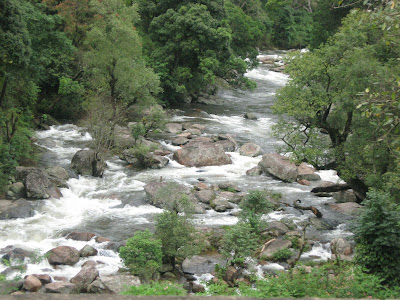
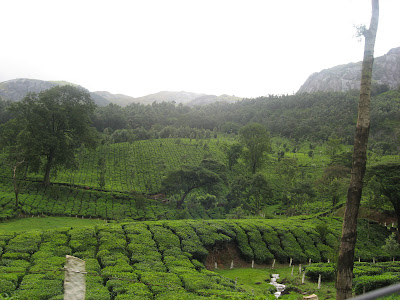
Vast stretches of tea plantations announced the approach of Munnar. It looks just like a green carpet from a distance, only that it is impossible for a weaver to create as many shades of green like nature does. I understand that the green carpet is a constant all the year round, but now, in the monsoon, it was absolutely breathtaking! Every few minutes we glimpsed waterfalls amidst the greenery, some simply thin streams of water flowing along the fissures in the rocks, while some were thundering along in full force over the rocks of the mountains smoothed over time.


Waterfalls.....


....and Tea Plantations......

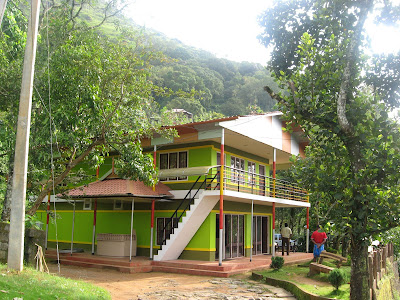
By the time we reached Munnar town, it was evening, and Sankar managed to contact a friend of his, who arranged a room for us. We were first told that it was about 2Kms from the town, but ended up about 5Kms from the town. The place had no name. It seemed to be an extension (probably illegal) of the Sun Mount View hotel, but the rooms were very comfortable, and we had a view over the valley and the mountains beyond them. We took over 2 rooms and were glad to call it a day after dinner at the Whispering Meadows, a Km further from our place.


Our Cottage

We needed all the rest we could get, so as to be ready for a the day ahead, for we planned to do all the sightseeing we could in a day before returning to Tiruppur. Keep looking out for details of the wonderful day we had in Munnar.......

Kumbhalgarh - A glimpse into the past

Nestled among the mighty Aravallis are many forts of the Rajputs, each one greater than the other, each one relating a story of its own, a story which is part history, part legend, but which gives each of these forts its own unique identity. The Kumbhalgarh fort in Rajasmand district of Rajasthan is one such fort which has its own story to tell.

Kumbhalgarh Fort

Kumbhalgarh is about 90 km from both, Udaipur as well as Falna. We took the Ranakpur express from Mumbai to Falna, and a cab from the Falna station to Kumbhalgarh. The 2 ½ hours drive took us through lush green fields and rocky mountains welcoming us to a part of Rajasthan we had never seen before.


Our destination was the Club Mahindra Resort, 5 Km from the fort. The other options for accommodation near the fort are ‘The Aodhi’, a favorite with foreign tourists, ‘The Dera Tented Resort’, which offers variety and adventure in the form of luxurious tents, the ‘Kumbhal Castle’, and the ‘Tiger Valley Resort’.

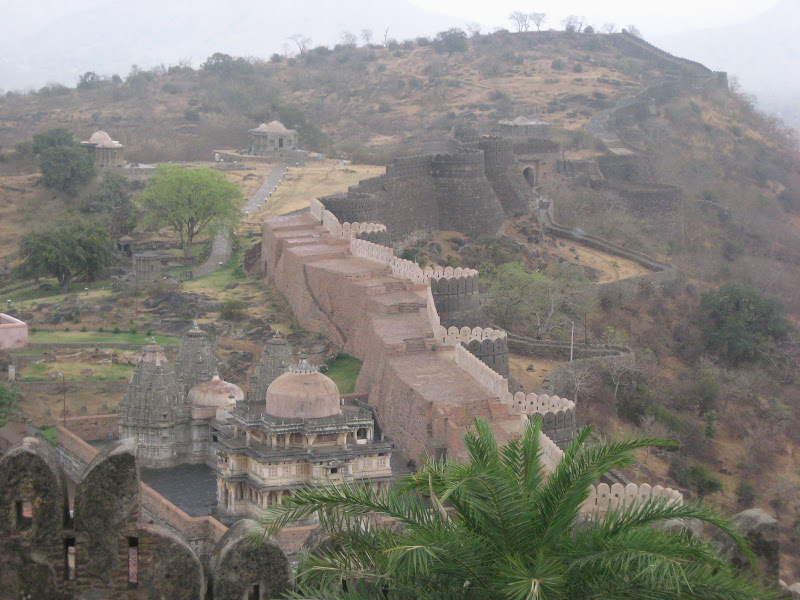
A View of the wall of Kumbhalgarh Fort
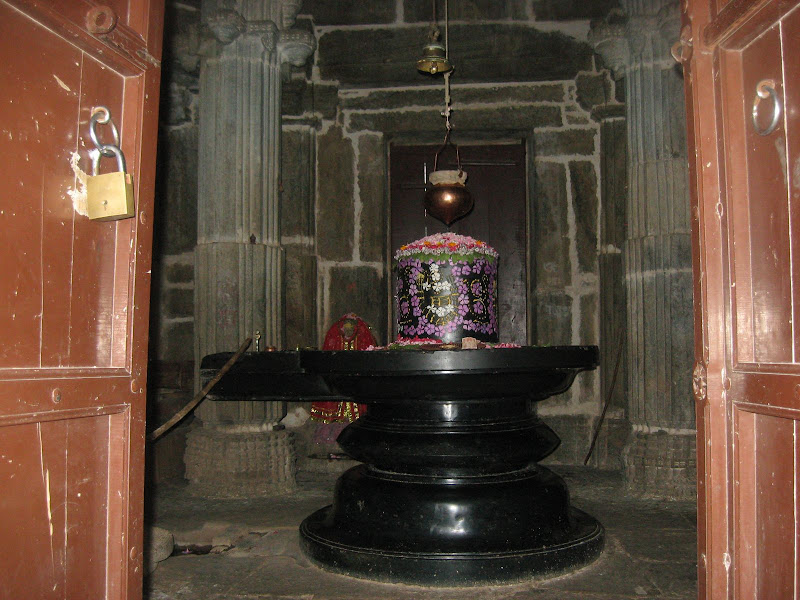
The Kumbhalgarh fort was built by Rana Kumbha to defend his kingdom from the Mughal invaders, and the USP of the fort is its 36 km – long wall, said to be the second largest after the Great Wall of China. However, the fort wasn’t the first structure to be built at this place. In ancient times, it was the capital of a Jain king, who built about 300 temples at this place. Rana Kumbha added to this and at the peak of its fame, the fort had a total of 360 temples within its walls, 300 of Jains, and 60 of Hindu gods. Today, few of these are left, fewer with idols inside. Of these, the Neelkanth Mahadeo Temple has pride of place, having been the chosen deity of Rana Kumbha. The 5 feet high Shivaling in this temple was personally cared for by the king who, it is said, towered over the lingam at 8 feet. Ironically, it was while he was praying to this idol that he was stabbed in the back by his own son, who, again ironically, was the father of the great Maharana Pratap.

The idol of Neelkanth Mahadeo


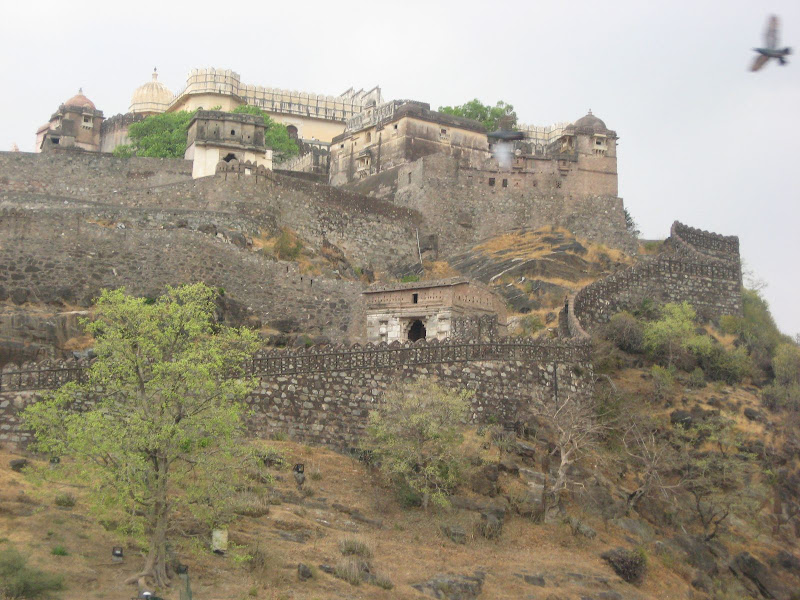
The fort itself is very impressive, and one can spend hours roaming over the vast area, if only there was someone to guide us. As it is, the only effort the government is making to popularize the fort is in the form of a sound and light show, as part of which, the fort is lit up every evening between 7:30 and 8:00PM. This is really a very beautiful sight, one which every visitor must look forward to. The palace, at the highest point of the fort is however, not all that impressive, or rather, unlike what one expects of a Rajasthan Palace. This palace, in fact, is the birthplace of Maharana Pratap, and deserves a lot more care and maintenance.

A View of the Palace

Rana Kumbha was well known, not only for his valour, but also for his large-heartedness, his generosity, as well as righteousness. Kumbhalgarh abounds with legends connected to him, and when one hears these legends from the mouths of the locals who make up for the scarcity of guides, one can actually imagine the great man who made this difficult terrain his home, and feel his presence lingering around……

Rana Kumbha

There are quite a lot of places to visit around Kumbhalgarh-

The Kumbhalgarh Wildlife Sanctuary (5 Km) – The Jungle safari is a must for nature lovers. Don’t have great expectations with regard to animals, and you won’t be disappointed.


The Parshuram Mahadeo Temple (20Kms) – A Cave temple approachable from Falna as well as Kumbhalgarh, it involves a 1 ¼ Km trek to the cave where Lord Shiva blessed Sage Parshuram. Water permanently trickling down on a natural Shivaling is a wonder of nature. This temple is a must-visit for those who are spiritually inclined, as well as those who aren’t.


The Ranakpur Jain Temples (50 Kms) - Architectural wonders!


Mucchal Mahavir (25Kms) – Jain temple

Ganesh Temple (Ghanerao) (25Kms) – Life-size statues of Lord Ganesha and his consorts Riddhi and Siddhi.


Haldighati (25 Km), Nathdwara (50 Km), and Udaipur (90 Km) are also easily accessible from Kumbhalgarh.


Kumbhalgarh Trip- Day2- The Kumbhalgarh Fort

We spent the first day at the resort catching up on sleep, and the second morning passed by just getting acquainted with the resort. I was looking forward to going to the fort soon. We had been told that the best time to visit it would be in the evening, as the fort would be lit up around 7 P.M. We left the resort around 4 P.M. so that we could take in the sights before it got dark, and then wait until the lights were switched on. The weather had been pleasant since our arrival, which in itself was surprising. We had expected it to be quite hot, and packed in all our summer things. It turned out to be quite cool up there, and that evening it was also a bit cloudy.


Our first view of the Kumbhalgarh fort

The Kumbhalgarh fort is an impressive edifice that remains hidden from view till the last bend in the road, less than a kilometer away. It is only after we enter the first gate of the fort, and the road turns towards the fort, that we can get our first glimpse of the fort and its famous wall.


The first gate of the fort

The driver of our vehicle stopped at the main entrance, where we had to buy a ticket for entering the fort, and told us to just follow the road to the left. Right at the entrance was a temple to Lord Ganesh.

The Ganesh Temple

We had scarcely set foot inside the fort that it started raining!!! It wasn’t a very heavy rain, but at that height, along with the strong wind, it was quite an experience, climbing up the steep path to the palace at the top of the fort in the pouring rain. I have always enjoyed getting wet in the rain, and it was a pleasure to get soaked at such an altitude. Even more than that, it was good to see that Samhith too enjoyed the rain, and made the most of it. He ran on, ahead of us until I scolded him and made him hold one of our hands. The wind was so strong, and the path so steep, I was afraid of him falling down, but thank goodness, nothing of the kind happened!


We walked along, enjoying the view, and appreciating the way the fort and palace had been built. There was a sign right at the top, pointing out the place Maharana Pratap had been born, and we expected someone to be there , someone who would tell us the story of the fort, but everything was securely locked, and there seemed no sign of life anywhere around. It was only after we tried out another path to the palace that we found one, single door open, and a watchman, who wasn’t too interested in talking to tourists. There were a couple of other families there, also from our resort, who seemed to be a little more informed about the fort than we were, so after a round of the palace, and a small temple of Durga Maa inside a smaller palace, we turned our steps downwards, towards the temples we could see at the ground level.


Inside the palace


The Durga Temple inside the palace

The first two temples that we saw were closed, and we were told that there were no idols inside. So, we turned towards the wall which had been beckoning us ever since we entered. There are points all along the wall (on the inside, of course), where one can climb up to the wall, but only some are in good condition. We used one of these to get up there, and it really was awesome! We had heard that the wall was broad enough for four horses to move along at the same time, but up close, it looked even broader. Four horses wouldn’t have had to move very close to each other at any point on the wall!!!


The wall, we learnt, had been built over a period of 14 years, and was about 36 Km long! The men must have been skillful indeed to have built such a masterpiece which has survived centuries, and still is in such good shape. I can’t imagine a building of today surviving even a fraction of the period, when subjected to the vagaries of nature, as this one would have faced!!! The wall apparently is in good condition all over, except one section, which crumbled recently. But here, it must be mentioned, that there is a serious lack of interest displayed by the authorities here. It is true that over the past few years, the government has tried to restore the palace, temples, and fort, and make it a tourist attraction, (the evening lighting, and a proposed sound and light show are efforts which the govt. is making in this direction), but much more can be done. For example, it is only part of the wall that has been cleaned, making it possible to walk on it. The rest of the wall lies in disrepair. When we asked if it was possible to walk all along the wall, we were met by stares, rather than answers. It is a matter of great pride that we have places like this in our country, but we need to make a lot more effort to maintain them, and make them attractive enough to draw more people towards them. It might not be possible for people to walk the entire length of the wall, but I am sure there are more people like me out there, who would like to make more trips to different sections of the wall, and visit the other temples which are inside the fort complex, but much farther away.


A View of the Palace from the wall

Talking of temples, it seems there are 360 temples inside the fort, of which 60 are Hindu temples, built by Maharana Kumbha, while 300 are Jain temples, which date back to the 6th or 7th century, when the Jain king, Samprati ruled over this place. Most of these temples are in ruins and only a few have idols now. Of these, the most important one is the Neelkanth Mahadeo Temple, the chosen deity of Maharana Kumbha and his family.


The main Shivaling, Neelkanth Mahadeo, is an impressive one, being about 5 Feet in height. It was here that we found an old man, who, when asked, happily recounted to us the story of this impressive fort.

Meanwhile, let me move on ……. After we spent some time at the temple enjoying the view, and thrilled to see a peacock, we headed back to the wall to see the lighting. The lights are put on every evening at 7:30P.M. for about 20 minutes, and it is, indeed an awesome sight. The fort glows gold against the black colour of the night, and one can just sit there for hours in the cool breeze, drinking in the sight. However, hours is what we don’t have, for we have to climb down the wall before the lights go off, and everything is black, so we hurried down back to the car, and on out return journey, managed to get a few photos of the fort while lit up.


This ended our jaunt to the fort, which is undoubtedly, one of the most impressive that I have ever seen. One of our fellow travelers from the resort told us that the Chittorgarh Fort is the best in the whole of the Mewar area of Rajasthan, even better than this one, but I can’t comment until I have actually seen it. Las year, we had visited Jodhpur and Jaisalmer, and though Mehrangarh Fort in Jodhpur is undoubtedly maintained much better, and the Jaisalmer fort is unique as the only fort in which people still live, this one has been much more impressive. It is here that one can actually imagine and feel the life that the Rajputs led- their valour, their pride and their greatness!